 | ||||
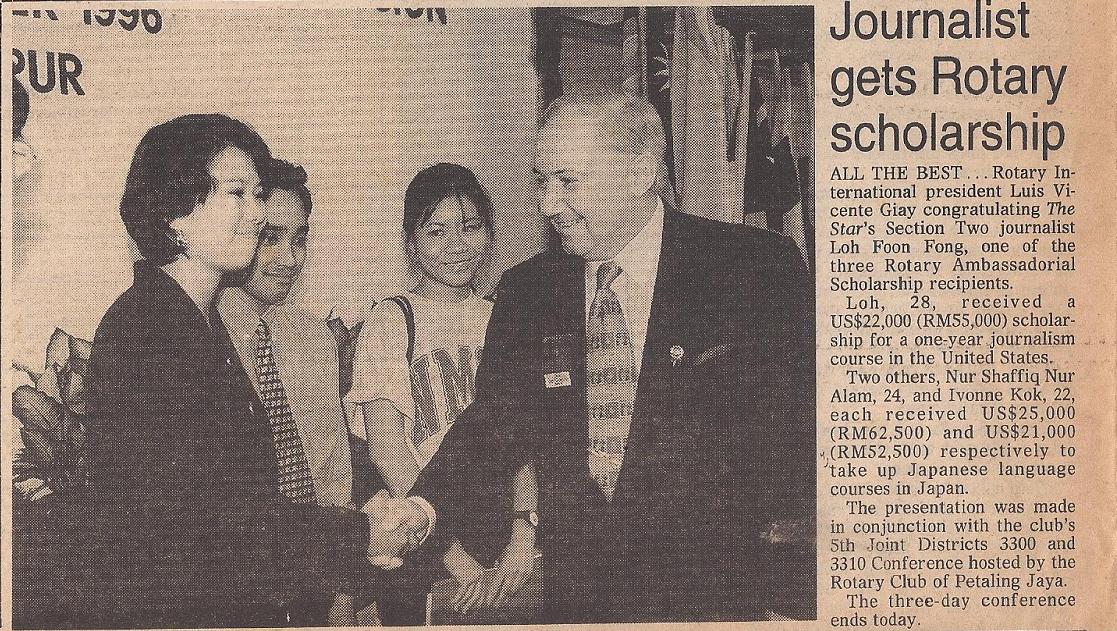
| Sunday Star, 24 November 1996 |
 |
| With the most important person - Mum - at the Rotary award presentation. |
*********************************************************************************************
The Star, Sunday, 21 December 1997 12:00 AM
The Star, Sunday, 21 December 1997 12:00 AM
Section: Education, Page 9
By LOH FOON FONG
By LOH FOON FONG
Taken with Boston's elegant charm
EVERY hour of daylight, the Charles
River that runs parallel to Boston University (BU) has visitors dying to be
near it. It sits confidently with its charm, enticing walkers, joggers,
skaters, cyclists, leisure sailors and day-dreamers.
Though not exactly crystal clean,
the sight of the river thrilled me the moment I set foot in BU. I then decided
to take up sailing under BU's Physical Education programme. It is a real haven
for relaxation.
 |
| MESSING ABOUT ON THE RIVER ... the Charles River is a hive of activity throughout the day. Here the writer (left) and a sailing friend are about to go on a boat ride. |
The university, "bestowed"
with the lovely river, is endowed with many other wonders. Covering about 30ha,
the various departments lining the seemingly endless boulevard of Commonwealth
Avenue (known simply as Comm Ave to locals) are interspersed with eateries, a
church, a library and covenience stores.
At the College of Communication, the
professors are mostly working professionals who come from interesting
backgrounds. A Boston Globe journalist, a CNN director and a former Wall Street
Journal journalist are among the professors teaching me this semester. Their
unique creative approaches, backed by active student participation, have made
classes very interesting.
On one occasion, two students stormed into our
class and started yelling and accusing our lecturer of plagiarism and for
trying to avoid them. The class was stunned, and we began to doubt the
credentials of our highly respected teacher as he handed out sheets of papers
outlining our assignment on the incident. It had been a set-up! "Throughout
this semester, expect the unexpected," he said as we burst into laughter.
While working on our assignments we
discovered the most striking characteristic of Americans their openness is a
culture that we Asian journalism students have found confounding but revered.
Racism for instance, is discussed openly. This characteristic has helped us
write comprehensive and fair stories without having to constantly punctuate
articles with "so and so declined comment", or "so and so could
not be reached for comment," which is irritatingly common in the Malaysian
media.
Here, even a mere student can call a CEO. They may not know you, but
chances are they will return your call and respond to your enquiries.
Information is easily accessed through the Internet and special interest
research institutions. The United States is certainly a conducive place to pick
up many journalistic skills.
As a university with among the
highest number of international students in New England, BU is a melting pot of
cultures. Students not only gain from the institution, but also from each
other. It is a great opportunity to learn to "network". With more
than 50 colleges and universities in Boston city and Greater Boston, students
are exposed to many great minds.
Across the Charles River, which
separates Boston and Cambridge, is the world renowned Harvard University and
Massachusetts Institute of Technology. Interesting professors and Nieman
Fellows (selected mid-profession scholars from various parts of the world) from
Harvard are frequently invited as speakers to BU.
Books aside, Kenmore Square, with
its many pubs, is a popular haunt for many university students. The square is
only a five minute walk from the College of Communication School. Located close
to the square is Fenway Park, which has earned a reputation in baseball's major
leagues. Described as Boston's most cherished landmark by the Lonely Planet
travel guide, Fenway Park is the home of the much loved Boston Red Sox baseball
team with well-known names of the past such as Babe Ruth and Ted Williams.
Boston city, as most locals would jovially reveal, began as cow paths, which
explains why the city is rather haphazardly developed.
With a rather simple lifestyle and
manageable pace of life, Boston is an easy place to adapt to. It is a relief
getting away from the hustle and bustle of Kuala Lumpur and the uncontrollable
traffic madness! However, being so used to new and modern Kuala Lumpur, I
initially found Boston old and drab. Its beauty, as travel guides, books and
friends have proclaimed, seemed over-rated. But just hold it there. Time is all
you need before its charms work on you.
The Charles River that cuts across
the city decorates the city's backdrop exquisitely. The suburbs, called Greater
Boston just a half hour drive away from the city is captivating. Tastefully
painted three-storey wooden bungalows line the shady streets. Each house is
different and unique, done up with much effort.
Most of all, the city is certainly
not dull. With interesting museums, broadway theatres, cinemas, galleries,
cafes and bars, Boston is ideal for cultural pursuits. The Museum of Fine Arts
in Huntington Avenue, Fenway, considered second only to New York's Metropolitan
Museum of Art, is a must for visitors here. It has an impressive collection of
art and artifacts from various parts of the world. Special exhibitions are held
regularly. Currently on display is Picasso's early works (before his cubism
attempt) which have awed many visitors with the painter's exploration and
flexibility in different painting styles.
Newbury Street, just a 20-minute
walk from BU's main campus, along with Cambridge's Harvard Square, strikes out
as the most interesting spots in Boston. Both are filled with bookstores,
boutiques, interesting cafes and shops, and street musicians. The Let's Go
travel guide aptly describes Newbury Street as Boston's most flamboyant
promenade. The street certainly has a distinct character from the rest of
Boston. Besides the colourful street, its residents are lively and diverse,
sporting styles that range from the latest elegant fashion to punk.
Boston's affluent neighbourhood,
Beacon Hill, is a picturesque spot. A haven for photography, Beacon Hill is
laid with brick sidewalks and cobblestone alleyways. Its 19th-century
townhouses have little courtyards and rooftop gardens. Quaint gas street
lanterns light the streets night and day. Adjacent to Beacon Hill are two large
parks, the 20ha Boston Common, the country's oldest public park built in 1634,
and the 24-acre Public Garden.
For a rich cultural experience,
exlore the North End Italian community with its authentic Italian food of
homemade pastas, pizzas, fresh breads and pastries. Festivals held in the
summer are exciting and colourful. Chinatown, where Asian food is aplenty, adds
an oriental touch to Boston. Recently opened Malaysian restaurants like Penang
and Pandan Leaf are a hit among Americans and foreigners.
For newcomers and visitors, downtown
Boston's 4km, Freedom Trail is worth exploring on foot. With its many
historical landmarks, it provides a good introduction to Boston, one of the
early British settlements in the 17th century. Together with Boston as part of
Massachusetts, are Rhode Island, Connecticut and New Hampshire which made up
New England. After several months here, I would say Boston suits me fine. I
have settled down nicely and find the environment most conducive for study.
* Loh Foon Fong
is a journalist of The Star who is pursuing a Masters degree in Print
Journalism at the Boston University.
 |
|
Autumn changes along Charles River Nov 1997. Managed to capture this changing shades from
a bridge that links the back of Boston University to Storrow Drive.
|
 |
| While pursuing a Master of Science in Print Journalism, the writer (standing) is required to give talks about Malaysia to American Rotarians as part of her "ambassadorial" duties for being the Rotary Ambassadorial Scholar 1997/98. Slides of Malaysian life, population, food, culture, etc, which she had prepared are shown to these Rotarians at the Charles River Club in Natick on February 19, 1998. |
 |
|
With Rotary Host Counsellor, the late Jean, left, and
her husband Peter Fox in 1998. Lovely couple who have made my time in Boston
wonderful. We had many interesting exchanges about food, culture, politics and just
about anything about our countries.
|
 |
|
The writer, left, with her astounding academic adviser,
then 70-year-old, Prof Keith Botsford, middle, and her other course mates in
Critical Journalism class 1998. Keith had kindly invited us all for dinner (in
which he personally prepared) at the end of the course. The course was so
tough! (hence, the small number of students) The writing included topics
relating to philosophy, critique of some abstract passages and books. Keith
really stretched me. There were moments I wished I had taken Video Production,
which I initially and badly wanted to but when you have an academic adviser who
told you to take his paper, it was difficult to say “no” as it would not make
sense not to take any of his papers when I was under his tutelage. The Video Production that teaches a skill was
enticing to me but I knew deep down that I should opt for the other that
stretches the mind and soul. And so I took the bull by the horns and rode along
with it since I thought it was my destiny to be assigned to such a highly
demanding teacher. While in it, I did wonder if I had jumped into it out of
stupidity or madness. I was not surprised when some Americans opted out from
having him as the adviser or from taking his course. There was no turning back
for me and I soon discovered that Keith was an icon in the literary world as
well as an amazing character in person, one who cared deeply for all his
students. He probably saw me as the Asian student who barely survived his class
but for me, no value could be put to life’s lessons – from the interactions we
had with him, even though it was just a brief one semester. Check out Keith Botsford
in Wikipedia.
|

