Friday, January 1, 2010

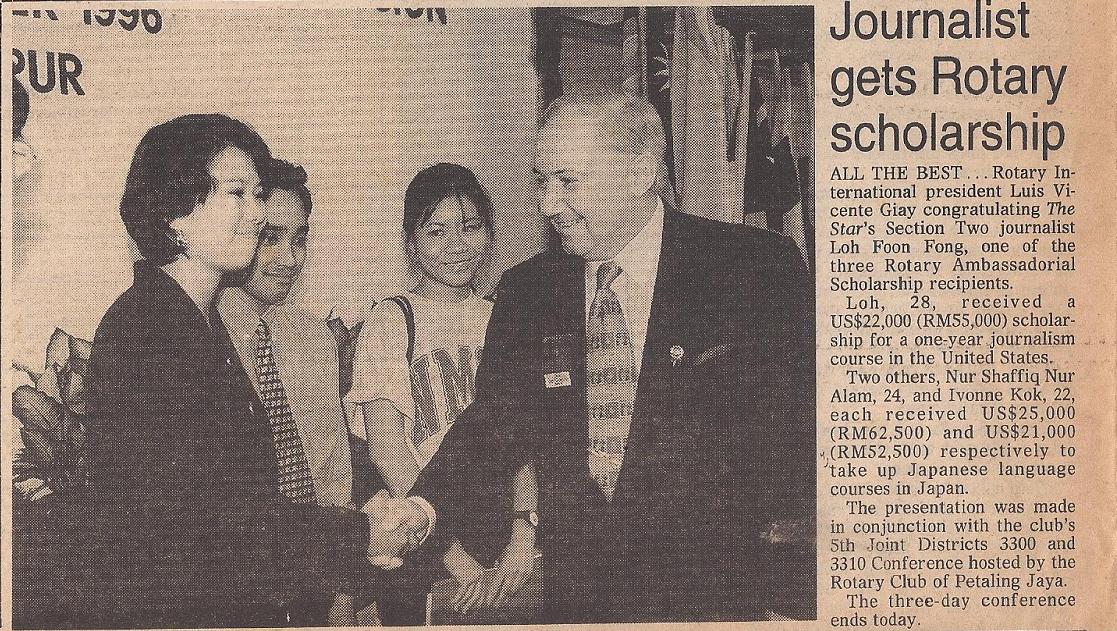
Rotary Foundation Ambassadorial Scholar 1997/98


Sunday Star, 24 November 1996
With the most important person - Mum - at the Rotary award presentation.


*********************************************************************************************

The Star, Sunday, 21 December 1997 12:00 AM
Section: Education, Page 9

By LOH FOON FONG
Taken with Boston's elegant charm
EVERY hour of daylight, the Charles River that runs parallel to Boston University (BU) has visitors dying to be near it. It sits confidently with its charm, enticing walkers, joggers, skaters, cyclists, leisure sailors and day-dreamers.

Though not exactly crystal clean, the sight of the river thrilled me the moment I set foot in BU. I then decided to take up sailing under BU's Physical Education programme. It is a real haven for relaxation.

MESSING ABOUT ON THE RIVER ... the Charles River is a hive of activity throughout the day. Here the writer (left) and a sailing friend are about to go on a boat ride.

The university, "bestowed" with the lovely river, is endowed with many other wonders. Covering about 30ha, the various departments lining the seemingly endless boulevard of Commonwealth Avenue (known simply as Comm Ave to locals) are interspersed with eateries, a church, a library and covenience stores.

At the College of Communication, the professors are mostly working professionals who come from interesting backgrounds. A Boston Globe journalist, a CNN director and a former Wall Street Journal journalist are among the professors teaching me this semester. Their unique creative approaches, backed by active student participation, have made classes very interesting.

On one occasion, two students stormed into our class and started yelling and accusing our lecturer of plagiarism and for trying to avoid them. The class was stunned, and we began to doubt the credentials of our highly respected teacher as he handed out sheets of papers outlining our assignment on the incident. It had been a set-up! "Throughout this semester, expect the unexpected," he said as we burst into laughter.

While working on our assignments we discovered the most striking characteristic of Americans their openness is a culture that we Asian journalism students have found confounding but revered. Racism for instance, is discussed openly. This characteristic has helped us write comprehensive and fair stories without having to constantly punctuate articles with "so and so declined comment", or "so and so could not be reached for comment," which is irritatingly common in the Malaysian media.

Here, even a mere student can call a CEO. They may not know you, but chances are they will return your call and respond to your enquiries. Information is easily accessed through the Internet and special interest research institutions. The United States is certainly a conducive place to pick up many journalistic skills.

As a university with among the highest number of international students in New England, BU is a melting pot of cultures. Students not only gain from the institution, but also from each other. It is a great opportunity to learn to "network". With more than 50 colleges and universities in Boston city and Greater Boston, students are exposed to many great minds.

Across the Charles River, which separates Boston and Cambridge, is the world renowned Harvard University and Massachusetts Institute of Technology. Interesting professors and Nieman Fellows (selected mid-profession scholars from various parts of the world) from Harvard are frequently invited as speakers to BU.

Books aside, Kenmore Square, with its many pubs, is a popular haunt for many university students. The square is only a five minute walk from the College of Communication School. Located close to the square is Fenway Park, which has earned a reputation in baseball's major leagues. Described as Boston's most cherished landmark by the Lonely Planet travel guide, Fenway Park is the home of the much loved Boston Red Sox baseball team with well-known names of the past such as Babe Ruth and Ted Williams. Boston city, as most locals would jovially reveal, began as cow paths, which explains why the city is rather haphazardly developed.

With a rather simple lifestyle and manageable pace of life, Boston is an easy place to adapt to. It is a relief getting away from the hustle and bustle of Kuala Lumpur and the uncontrollable traffic madness! However, being so used to new and modern Kuala Lumpur, I initially found Boston old and drab. Its beauty, as travel guides, books and friends have proclaimed, seemed over-rated. But just hold it there. Time is all you need before its charms work on you.

The Charles River that cuts across the city decorates the city's backdrop exquisitely. The suburbs, called Greater Boston just a half hour drive away from the city is captivating. Tastefully painted three-storey wooden bungalows line the shady streets. Each house is different and unique, done up with much effort.
Most of all, the city is certainly not dull. With interesting museums, broadway theatres, cinemas, galleries, cafes and bars, Boston is ideal for cultural pursuits. The Museum of Fine Arts in Huntington Avenue, Fenway, considered second only to New York's Metropolitan Museum of Art, is a must for visitors here. It has an impressive collection of art and artifacts from various parts of the world. Special exhibitions are held regularly. Currently on display is Picasso's early works (before his cubism attempt) which have awed many visitors with the painter's exploration and flexibility in different painting styles.

Newbury Street, just a 20-minute walk from BU's main campus, along with Cambridge's Harvard Square, strikes out as the most interesting spots in Boston. Both are filled with bookstores, boutiques, interesting cafes and shops, and street musicians. The Let's Go travel guide aptly describes Newbury Street as Boston's most flamboyant promenade. The street certainly has a distinct character from the rest of Boston. Besides the colourful street, its residents are lively and diverse, sporting styles that range from the latest elegant fashion to punk.

Boston's affluent neighbourhood, Beacon Hill, is a picturesque spot. A haven for photography, Beacon Hill is laid with brick sidewalks and cobblestone alleyways. Its 19th-century townhouses have little courtyards and rooftop gardens. Quaint gas street lanterns light the streets night and day. Adjacent to Beacon Hill are two large parks, the 20ha Boston Common, the country's oldest public park built in 1634, and the 24-acre Public Garden.

For a rich cultural experience, exlore the North End Italian community with its authentic Italian food of homemade pastas, pizzas, fresh breads and pastries. Festivals held in the summer are exciting and colourful. Chinatown, where Asian food is aplenty, adds an oriental touch to Boston. Recently opened Malaysian restaurants like Penang and Pandan Leaf are a hit among Americans and foreigners.

For newcomers and visitors, downtown Boston's 4km, Freedom Trail is worth exploring on foot. With its many historical landmarks, it provides a good introduction to Boston, one of the early British settlements in the 17th century. Together with Boston as part of Massachusetts, are Rhode Island, Connecticut and New Hampshire which made up New England. After several months here, I would say Boston suits me fine. I have settled down nicely and find the environment most conducive for study.

* Loh Foon Fong is a journalist of The Star who is pursuing a Masters degree in Print Journalism at the Boston University.


*********************************************************************************************


Autumn changes along Charles River Nov 1997. Managed to capture this changing shades from a bridge that links the back of Boston University to Storrow Drive.


While pursuing a Master of Science in Print Journalism, the writer (standing) is required to give talks about Malaysia to American Rotarians as part of her "ambassadorial" duties for being the Rotary Ambassadorial Scholar 1997/98. Slides of Malaysian life, population, food, culture, etc, which she had prepared are shown to these Rotarians at the Charles River Club in Natick on February 19, 1998.

With Rotary Host Counsellor, the late Jean, left, and her husband Peter Fox in 1998. Lovely couple who have made my time in Boston wonderful. We had many interesting exchanges about food, culture, politics and just about anything about our countries.


The writer, left, with her astounding academic adviser, then 70-year-old, Prof Keith Botsford, middle, and her other course mates in Critical Journalism class 1998. Keith had kindly invited us all for dinner (in which he personally prepared) at the end of the course. The course was so tough! (hence, the small number of students) The writing included topics relating to philosophy, critique of some abstract passages and books. Keith really stretched me. There were moments I wished I had taken Video Production, which I initially and badly wanted to but when you have an academic adviser who told you to take his paper, it was difficult to say “no” as it would not make sense not to take any of his papers when I was under his tutelage.  The Video Production that teaches a skill was enticing to me but I knew deep down that I should opt for the other that stretches the mind and soul. And so I took the bull by the horns and rode along with it since I thought it was my destiny to be assigned to such a highly demanding teacher. While in it, I did wonder if I had jumped into it out of stupidity or madness. I was not surprised when some Americans opted out from having him as the adviser or from taking his course. There was no turning back for me and I soon discovered that Keith was an icon in the literary world as well as an amazing character in person, one who cared deeply for all his students. He probably saw me as the Asian student who barely survived his class but for me, no value could be put to life’s lessons – from the interactions we had with him, even though it was just a brief one semester. Check out Keith Botsford in Wikipedia.

Friday, September 18, 2009

Bar Council: Govt must act on reports of Penan girls being raped

The Star

BY LOH FOON FONG
foonfong@thestar.com.my

KUALA LUMPUR: The Bar Council is disappointed with the Government’s continued lack of political will in ensuring that the welfare and rights of indigenous people throughout Malaysia are protected.
Its president Ragunath Kesavan said the Government’s inaction makes a mockery of its vote in favour of adopting the United Nations Declaration on the Rights of Indigenous Peoples 2007, he said.
“We strongly urge the Government to perform its duty by taking concrete steps to improve the welfare of the indigenous peoples,” he said in a statement Friday.
Ragunath said the Bar Council was disappointed with the Government’s initial refusal to make public the report of the National Task Force established to investigate the allegations of sexual abuse against the Penan women and girls.
He also said they were disappointed that despite the Inspector-General of Police’s pledge of full support for a joint police-NGO investigation mission, the Sarawak police had reportedly stated that the funds allocated for the project were not sufficient for the NGOs participation.
“The sexual abuse faced by the Penans is but one of a multitude of human rights violations that indigenous communities face on an ongoing basis,” he said.
Ragunath said the Bar Council was concerned that many indigenous communities still live without basic amenities and infrastructure and were deprived of their rights to ancestral lands and access to basic services have made them vulnerable to sexual abuse and other human rights violations.
“The Goverment must fulfill its state obligations by formally recognising, protecting and guaranteeing the rights of indigenous peoples to their ancestral lands throughout the country and gazetting such ancestral lands as reserved areas for them,” he said.
The Bar Council also denounced the arrest of 15 Sarawakian indigenous leaders on Sept 16 who were reportedly detained as they tried to deliver a memorandum to the Chief Minister to protest the building of hydro-electric dams that would adversely affect their communities, he said.

Friday, September 11, 2009

The rape of young Penan girls

The star

BY STEPHEN THEN, SHARON LING, LOH FOON FONG, FLORENCE A. SAMY AND R.K. SHYAMALA


Allegations of Penan girls and women being raped and molested by timber company workers in the Baram district in Sarawak have been confirmed to be true.
A special committee set up by the Women, Family and Community Development Ministry revealed that at least seven girls and women were raped and molested - confi rming a news report by The Star late last year.
The horror the Penan girls and women went through.
● A girl, 12, was raped by a stranger outside her hostel and by a timber worker when she took a lift in a timber company’s vehicle from her village in Long Kawi to her school in Long Lama. She got pregnant, quit school and married a Penan man.
● A woman from Long Item was raped by a timber worker in 2005 and 2007 and gave birth to a baby girl, now two years old.
● One was raped by an Iban timber worker when she was kidnapped at the age of 13, while visiting her relatives in Miri.
● One was almost raped when she took a lift with her father from a timber company to apply for an identity card.
● In Long Muboi, a student said her 14-year-old friend was molested by a truck driver who gave her a lift to school.
● A 17-year-old girl gave birth to a child and her neighbours claimed that she had sexual relations with the timber workers.
● A group of women said they believed that sex exploitation exists among the Penan women and girls but they were too ashamed to tell their stories.

The Star
Friday September 11, 2009

Panel: Most had problems getting IDs

PETALING JAYA: The national action task force committee that investigated allegations of sex abuse of Penan women in Sarawak found that most of them had difficulty in getting identification documents.
This was due to poverty, the long distance from their villages to town and basic ignorance on the need to get the documents.
It found that many parents were poor and could not provide their children with basic schooling. The lack of transportation had also prevented them from sending their children to school.
The 112-page report noted that health facilities were located far from their settlement and most did not get any form of immunisation and most babies were received by mid-wives.
The committee was headed by then Women, Family and Community Development Minister Datuk Seri Ng Yen Yen.

Sunday, October 28, 2007

Healthy, friendly Japan


The Star

The Japanese are known to have the longest life span on earth, and that has not happened by chance. The Star had a glimpse of their mindful and purposeful healthy living practices that amazingly permeates all aspects of their lives.

By LOH FOON FONG
MANY have wondered and even examined the diet and lifestyle that contribute to the long life span of the Japanese.
With life expectancy a high 82 years, they are the most long-lived people in the world and it is widely known that the low-fat traditional Japanese diet, made up of rice, some meat, various vegetables and soy-based products, has a lot to do with it.
“The longevity that the Japanese enjoy today is the result of their consumption of traditional Japanese food, although that may not be the practice now,” said Futami Daisuke, senior managing director at the Japan Dietetic Association in Tokyo recently.
The Japanese government provides healthy lunches to almost all public schools to encourage children to eat healthily.
Today, Japan battles with obesity and lifestyle-related diseases like any other advanced nation.
According to the Japanese Ministry of Health, Labour and Welfare’s National Health and Nutrition Survey, the proportion of obese (BMI 25 or more) Japanese men in 2005 increased, with one in three men between 40 and 60 years old affected.
Ironically, among its women, one in five between ages 20 and 30 are too thin (BMI 18.5 or below), resulting in low birth weight babies, said Daisuke.
Will the growing obesity problem shorten the lives of the Japanese?
Daisuke said it is unlikely.
“In fact, with better diet, it is possible for our life expectancy to increase by another three years,” he said.
Knowing the benefits of the Japanese traditional diet is one thing, but maintaining the good diet can be a challenge amidst burgeoning fast food and pre-packed meals.
In this respect, the Japanese do not take things lying down but continue to beef up healthy diet efforts.
In schools, for instance, despite more than half a century after World War II, and with most Japanese no longer poor, the Government continues to provide healthy lunch meals at a highly subsidised rate in public schools.
“Almost all public schools have lunch meals based mainly on the traditional Japanese diet. This is to encourage good diet and healthy eating habits,” said Daisuke, one of the speakers invited by Yakult Honsha to give foreign journalists a talk on the Japanese health status.
More than that, in recent years, a national registered dietician is put in every school. Besides planning for the children’s diet, they now teach children about balanced and healthy diets, he said.
“This is an unprecedented initiative in the world,” he said.
Before, only one dietician takes charge of several schools to ensure proper meals are planned for the children.
The Japanese’s longevity is not just based on good diet but also supported by a good health system and government initiatives that promote healthy living, said Daisuke.
Their health efforts received a greater boost in mid 2005 when the Syokuiku Promotion Law (that draws out the basic philosophy for dietary education and legal framework) was introduced.
“Syokuiku Promotion is necessary for living and is considered an intellectual, moral and physical education necessity,” said Miho Kawano, assistant counsellor at the Food Promotion Cabinet Office.
It is a national movement that nurtures people into practising a healthy lifestyle, she said in her talk Formulation of Basic Syokuiku Promotion Law and Syokuiku Promotion.
(The Syokuiku Promotion Law is currently voluntary for the people and organisations to implement.)
The Syokuiku Promotion is not only about improving diet but also about deepening understanding and appreciation of food, continuing traditional food culture practices and considering diet that takes advantage of regional uniqueness,” she said.
That is because, just like other advanced countries, Kawano said there is concern in Japan about dietary change due to lifestyle changes, increase in nutritionally unbalanced or irregular foods, increase in obesity and lifestyle related diseases, increase in extremely thin women, outbreaks linked to food safety, dependence on food from abroad and loss of traditional culinary culture.
Children are having dinner with the whole family less frequently, and there is an increasing trend for people to eat out, eat pre-prepared foods and skipping breakfast, she said.
There is also a trend towards taking excessive amount of fat and less vegetables, she said.
More than 16.2 million people or 1% of the population are suspected of having diabetes, and one in two men or one in five women between ages 40 and 74 are suspected of having metabolic syndrome, she said.
To increase health awareness, a handbook on dietary education is distributed to families, nurseries and schools, she said.
“There was an aggressive introduction of local cuisine into school lunches and schools are encouraged to use food ingredients from their own prefecture. This is to encourage them to appreciate local produce,” she said.
National registered dieticians, chefs and cooks are stationed in schools to beef up health awareness and create a healthy diet, she said.
In the larger community, communication is encouraged between manufacturers and consumers and farmers are encouraged to rejuvenate environmentally sound practices in the agriculture, forestry and fishing industries.
The promotion of these practices are done through hands-on activities for children such as cutting rice and working in a dairy farm while city folks are encouraged, through green tourism, to visit agricultural villages.
Besides governmental efforts, the business community too is very involved in promoting health food.
A whopping 703 food products have been given the Foshu (Food for Specified Health Uses) approval, said Toshiaki Kitsukawa, director of Food for Specified Health Uses Department at the Japan Health Food and Nutrition Food Association.
The market size of Foshu products in 2005 amounted to 630 billion yen, similar to that of over-the-counter drugs in Japan, he said.
The Foshu mark, introduced in 1991 by the Ministry of Health, Labour and Welfare in Japan, is for products that have positive mild effects on a person’s health such as foods for special dietary uses, foods with health claims (such as Foshu) and foods with nutritional function claims.
“The Foshu system came out of an increased health awareness among Japanese and their demand for positive use of various food functions to improve public health,” said Kitsukawa in his paper Foods for Specified Health Uses (Foshu) and the Claims regulation in Japan.
With such highly visionary and responsible practices, one need not wonder why the Japanese continue to enjoy healthy long lives.

  • The writer was in Japan for 10 days, enjoyed Japanese food, and was happy to have lost 2kg excess fat without dieting. She also did not suffer from shoulder aches and breathlessness as she often does when eating out.


  • Gut knowledge

    Friendly bacteria is vital for good gut health.

    By LOH FOON FONG
    MOST Malaysians may know that beneficial bacteria are good for their gut, but not many know that Yakult was the first company in the world that came up with fermented milk drink containing beneficial bacteria.
    Senior managing director of Yakult Honsha and head of International Business Department Naomasa Tsuritani said Yakult has been ahead of the times in contributing to the health of the Japanese people.
    In 1930, professor at Kyoto University in Japan, Dr Minoru Shirota, discovered a resistant strain of the Lactobacillussubsequently called Lactobacillus casei Shirota.
    Three years later he became the first in the world to succeed culturing a fortified strain of lactic acid bacteria beneficial to human health, said William R. Henning Jr, public relations coordinator at the International Business Department of Yakult Honsha Co., Ltd.
    Yakult, a fermented milk drink that deliversLactobacillus casei Shirota strain to the intestines alive, was introduced to the world in 1935. The name originates from the Esperanto word “Jahurto”, meaning yoghurt.
    “Then, Japan was not a wealthy nation and medicine was only thought of as therapeutic medicine and Shirota’s main concern was to help people in rural areas who have little access to healthcare,” said Henning during a Yakult familiarisation trip in Tokyo for journalists.
    Hence, to best explain how Yakult benefits people’s health, direct communication was necessary and Yakult hired women to promote the products directly to the people.
    Until today, Yakult Ladies delivering the drink is the mark of the company.
    Senior managing director of Yakult Honsha and head of International Business Department Naomasa Tsuritani said besides the excellent healthcare and diet that had contributed to the Japanese longevity, Japan has for a long time made proactive efforts to embrace foods which are considered to be healthy and probiotic products has firmly been established in the Japanese diet for many years, he said.
    Moreover, building on the idea of using one’s diet to prevent lifestyle-related diseases, the Ministry of Health, Labour and Welfare has established the Foshu, the mark for foods for specific health uses, while new societal approaches, such as the movement for consumers to personally think about engaging in a healthy lifestyle, are being promoted.
    “In this context, we at Yakult have been ahead of the times in contributing to the health of Japanese people,” he said.
    Senior Research Fellow Dr Masaaki Watanuki of Yakult Central Institute for Microbiological Research in Tokyo said all of Yakult’s 34 functional food products have the Foshu (Food for Specified Health Uses) mark approved by the Ministry of Health, Labour and Welfare.
    In his presentation Probiotics and functional food, one health claim approved by Foshu is – the L. casei Shirota strain reaches the human intestine alive to effectively increase the population of good bacteria living there while reducing bad ones. This improves the intraintestinal environment and helps maintain the proper functioning of the digestive tract.
    From studies shown, there is a reduction of E. coli after consuming Yakult products for three weeks, said Watanuki.
    The gut is kept healthy when the good bacteria suppress the production of harmful substances released by intestinal bacteria and help with digestion and food absorption, synthesise vitamins and enhance immunity and resistance, he said.
    When there is an imbalance in the intestinal flora, it causes intestinal putrefaction, producing mutagenic/carcinogenic substances and toxins, he said.
    There are more than 300 species of bacteria living in a normal healthy gut and most are harmless but some potentially harmful, he said.
    “Of all the Lactobacillus strains, the Lactobacillus casei Shirota strain has the highest resistance against gastric juice and is able to reach the intestines alive and improve the balance of intestinal flora to positively affect our health,” he said.
    Lactobacilli and Bifidobacteria are the most significant bacteria that contribute to a healthy gut flora, he said.
    Besides fermented milk, Yakult also produces cosmetics and pharmaceuticals.
    Yakult’s cosmetics, mainly skincare products containing lactic acid bacteria and bifidobacteria and their metabolites, such as hyaluronic acid, and antioxidants, are ranked 31st in the Japanese cosmetics market, said Nakajima Kaoru, a staff member from Yakult Honsha Cosmetics Department.
    They are only sold in Japan, with some in Brazil, and are delivered house-to-house by Yakult Beauties, she said.
    On whether there is a limit to the number of bottles one could consume, Yakult Central Institute for Microbiological Research senior research fellow Masaroro Osamu said based on studies required by Foshu standard, people in the studies drank three bottles a day for two weeks and there had been no side effects.
    Yakult probiotic drink is ideally consumed within two weeks from the time it arrived at the supermarket. However, when kept in the fridge, it can last 45 days, he said.
    “It is best stored below 10 degrees Celsius and the drink should be discarded if it has been left outside the fridge for more than half a day,” he said adding that babies after six months old could also take the drink.
    On whether there has been any mutation of the Yakult bacteria strains, he said product character and stability had been checked and they are found to be stable.
    In natural sources, probiotic food are dietary fibre (such as whole grain), pectin and guagum while prebiotic food are food that contains oligosacharrides, he said.
    “Both probiotics and prebiotics are useful for health,” he said.

    Delivery ladies

    A look at the Yakult Ladies of Honsha Co. Ltd, one of the leading fermented milk drink suppliers in the country.

    By LOH FOON FONG
    IT was drizzling heavily on the morning we, journalists, set out on bicycles to observe the work of women delivering Yakult fermented milk drink and yoghurt to their neighbourhood in Japan.
    There are 593 Yakult centres in Tokyo itself and it takes 180 Yakult Ladies and 60 staff members to ensure smooth delivery of their products to a million customers daily, said Hitoshi Sasaki, president of the Yakult Touto Sales Co.
    Whether rain, shine or snow, the Japanese can be sure that a Yakult Lady will be there at their doorsteps supplying the probiotic drink. Yakult has been a household name in Japan for more than 70 years.
    The Japanese believe that besides a healthy traditional Japanese diet, it is important to keep the gut healthy by consuming probiotic (food containing beneficial bacteria) and prebiotic food (food for beneficial bacteria).
    The streets in the Edogawa district, Japan, were quiet and tranquil, since most adults had gone to work and children tucked away in schools.
    Kimiko Okuda, 36, cycled with a 30kg load of products kept in ice in a special storage box at the back of her bicycle and in the front basket.
    Everyday at 9am, from Monday to Saturday, Okuda, like all Yakult Ladies, goes to the Yakult Centre near her house to collect the stock for pre-ordered products as well as store up for those who wish to buy the products on the spot.
    By 1pm, Okuda returns to the Centre, returns unsold products and keeps an account of the sales she has made for the day.
    “I decided to take on the part time job to earn some money while the children are at school,” said Okuda who has two children in elementary school and one in kindergarten.
    Of all the products that the women distribute, the most popular products are the Lactobacilli fermented milk drinks, said Okuda.
    Yakult Lady Kimiko Okuda, 36, in a raincoat, delivers fermented milk to Katsuko Kobayashi, 71, in the Edogawa district of Japan.
    Other products distributed are the Lactobacilli drinkable, hard and soft type yoghurts, Bifidobacteria fermented milk drink and beverages with health benefits such as the sugar free tea Bansoreicha containing guava leaf polyphenols that helps moderate absorption of sugars.
    At one of the homes, Katsuko Kobayashi, 71, who looked twenty years younger than her age, said she started consuming the drink more than 40 years ago.
    “Now my grandchildren are also drinking it,” she said. She orders 20 bottles every week and gives them mostly to her grandchildren.
    Hiroyuki Wada, 56, owner of the Marumoriya Restaurant in Edogawa district, said he had been taking the drink for six years for they made him healthier.
    Car parts yard owner, a paraplegic and retirees were among those we encountered while trailing Okuda in her journey in that morning.
    There are 593 Yakult Centres in Tokyo and it takes 180 Yakult Ladies and 60 staff members from 15 Yakult Centres to ensure smooth delivery of the products to a one million population daily, said Hitoshi Sasaki, president of the Yakult Touto Sales Co.
    Its managing director Kouichi Nakayama said more than 60% of Yakult products in Japan are distributed by Yakult women while the rest are marketed through supermarkets, he said.
    “Door-to-door sales through the Yakult Lady system is more profitable than supermarkets sales,” he said.
    Women interested in the job can be high school or university graduates and there is no age limit, he said.
    Yakult Honsha Co., Ltd International Business Department’s public relations coordinator William R. Henning Jr said 35% of women in Japan deliver the products by car, 31% by motorbike, 28% by bicycle, and 3% each by walking and push cart.
    The Yakult Lady system started in 1963 and as of March, there are 43,753 Yakult women in Japan and 35,336 overseas, he said.
    “Everyday, more than 25 million people consume Yakult. The recommendation is for people to drink one bottle a day,” he said.
    In Malaysia, 31 Yakult women have been hired in Ijok, Kuala Selangor and Rawang, said Hideki Kawasaki, sales and marketing director of Yakult (Malaysia) Sdn Bhd, a wholly owned subsidiary of Japan-listed Yakult Honsha Co Ltd. established in 2002.
    “They only cover areas within their own neighbourhood. This helps ensure their safety as they are familiar with their own area and are within their own community,” he said.
    Yakult products were introduced to Malaysians in 2004. Currently, only its Lactobacilli fermented milk drink Yakult Ace is available in Malaysia.
    All of Yakult’s 34 functional food products have received the FOSHU mark, Japan’s recognition for food with specific health benefits.
  • Monday, February 27, 2006

    Maker of awesome automobiles

    The Star

    By LOH FOON FONG
    foonfong@thestar.com.my


    Stephan Schulte, VW’s managing director for sales and marketing in Dresden.
    We arrived at the Braunscheig-Wolfsburg Airport in Germany in a private jet! It had been sent by the directors from Volkswagen (VW) AG to rescue us Malaysian journalists from being stranded at the airport in Copenhagen following an industrial strike, late last month. After that, we were whisked off in a couple of Volkswagen (pronounced as Folks-vagen, meaning the “people’s car”) vehicles to our hotel.
    Riding in the premium-class and silent VW Phaeton – my first experience with a VW besides the Old Beetle – and travelling on the Autobahn (highway) with no speed limit, was an experience that could be compared with no other.
    It was initially frightening when the driver accelerated up to 250km/h. During the 25-minute journey, a Bugatti, also belonging to the VW Group, whizzed past us. For a moment, I thought: “Are we on another planet?”
    I was worried about safety until I had the opportunity to test-drive the VW Phaeton and the Golf GTI on the Autobahn from Wolfsburg to Dresden. At one point, when I was driving the VW Phaeton V6 TDI at about 180km/h and had to apply some emergency braking, I almost panicked, half expecting my chest to hit the steering wheel and the seat belt to pull so hard that it would hurt and the things in my bag to be strewn all over.
    Nothing like that happened. The Phaeton was unperturbed and held me in confidence. It won my trust from that instant.
    The Phaeton is handmade in Dresden, a town known for its artistic, cultural ambience and long tradition of distinguished craftsmanship in various skills. Phaeton car buyers get personalised service and get to participate in the building of their cars. They choose their own designs which gives each car its individuality and character, said Stephan Schulte, VW’s managing director for sales and marketing in Dresden.
    “We use the point of production as a point of sales as well,” said Schulte who added that VW’s motto is Build every car as though it is your own.
    Costing 100,000 euros (RM450,000) upwards, the Phaeton was introduced in 2002. Special additional features are notebook table, electric sunroof, solar cells, sunshade and a small fridge. Each car takes five working days to be completed.
    Last year, 23,000 units of the Phaeton were sold in Germany, half of the sales volume of the Mercedes S class, said Schulte. Its production increased by 20% last year compared with the year before, he said.
    The transparent factory in Dresden makes the Phaeton and the Bentley.
    “We probably need three or four generations of the car before we can bring it to the level of the Mercedes. The Phaeton is doing well considering that they are produced in a more competitive environment than before,” he said.
    Why do customers choose the Phaeton over other luxury cars?
    “One customer thinks it is our openness. One biker on a motorbike tour dropped by our factory and saw how we made the cars and he decided to buy a 12-cylinder Phaeton. Others like the interior and skilled craftsmanship,” he said.
    Driving on the Autobahn is the ultimate driving experience; it is no wonder that German cars are known for their precise engineering and craftsmanship. VW’s tagline – For the love of cars – describes the attention that goes into the making of its cars and the amazing qualities that make driving them a safe and enjoyable experience.
    The Volkswagen Group (Malaysia) was established recently and had invited the Malaysian media to visit its factories in Wolfsburg and Dresden to test out their cars.
    The Golf GTI, although a much smaller car than the Phaeton, is stable even at a speed of 200km/hour. The Touareg, an intelligent sports utility vehicle, can “climb” stairs, go on hilly slopes of up to 45° and over rocky roads and logs. It can also wade through 60cm-high snow. It has an automatic braking system when going downhill so drivers do not need to step on the brakes.
    The VW Group has two brand groups for its passenger cars – Audi and Volkswagen. The Audi brand group reflects the sporty image and comprises Audi, Seat and Lamborghini while the Volkswagen brand group reflects the classic image and they are the Volkswagen passenger cars, Skoda, Bentley and Bugatti.
    From three-litre to luxury class vehicles, each brand retains its unique brand image and operates as an independent entity on the market.
    The whole Volkswagen Group is coordinated from its headquarters in Wolfsburg, where strategically important decisions and technical innovations are made. There, almost every passenger car that zips past is bound to be a Volkswagen.
    Spanning 6.5sq km, the factory in Wolfsburg is the largest among its 47 factories spread throughout the world. It produces the Golf and the Touran.
    Up to 98% of the production at the factory is carried out by robots, said Alex Dumitrescu, the spokesman from the group communication and visitors’ services unit at Volkswagen AG.
    The different parts of cars are produced simultaneously and they are pieced together as one, said Dumitrescu who showed us how the Golf was made at the factory.
    Huge coils of sheet metal are rolled out and stamp-pressed into car body parts; six steps are required to shape each body part – doors, side panels and rear flaps – and six machines work one behind the other. Green press tools for making metal parts are carried by cranes.
    The Golf GTI is a powerful vehicle.
    “Welding is done by laser. It is clean and strong and hence less material is used,” said Dumitrescu.
    Each robot, which looks like a big mechanical hand, has a specific function: to attach car parts, tighten screws and nuts, make spot welds or put batteries and bumpers. Another robot views a car and makes adjustments to fit the back windscreen. Fifty robots work together to weld the side panels.
    “They work faster than humans and with hardly any errors,” said Dumitrescu.
    The factory’s 157km-long conveyor belt system transports cars from one assembly station to another.
    Workers work in three shifts and 3,000 cars are produced every day. There are 5,500 bicycles in the factory for workers to move around on.
    When the upper and the lower parts of the car are ready, a robot stamps the chassis number and the “wedding” occurs – the upper part moves downwards and the power train comes up on a delivery frame from the basement and is attached to the body.
    It takes 18 to 22 hours to make a Golf. The most powerful Golf is the Golf R32, a 250-horsepower car, said Dumitrescu.
    When the cars are completed, they are transported via a tunnel to two 48m high transparent glass towers, a visitors’ attraction at Wolfsburg, that can store up to 800 new vehicles.
    The factory also produces parts for VW car factories in Mexico, South Africa and China. There are 50,000 employees: 20,000 in the administrative section and 30,000 in the production section. Many of them have worked in VW all their lives; some families have worked there for a couple of generations. There has been no industrial strike although 97% of the workers are unionised, said Dumitrescu.
    Every day 500 to 600 customers (30% of customers) from within Germany and neighbouring countries travel to Wolfsburg to collect their cars. Most make it a daylong outing for the family. They collect their cars from the KundenCenter at Autostadt, a 250,000sq m complex that features two glass car towers, pavilions for various car models (Volkswagen, Bentley, Audi, Lamborghini, Skoda and Seat), a museum of automobile history, a hotel and a restaurant, and entertainment outlets amidst waterways, bridges, lakes and parks.
    Cars are polished and checked for the last time before they are handed over to customers who get 40 minutes of advice on how to handle their new cars.
    Each year, 1.2mil visitors go to the Autostadt to see the technology behind Volkswagen. Entrance fee is 14 euros (RM63) for adults and six euros (RM27) for children.
    Related story:

    Looking East


    Axel Barth, managing director of VW Group (M) Sdn Bhd.
    The Volkswagen (VW) Group is eager to produce cars for the Asean region and is still looking for a local partner to produce the cars with, after talks with Proton failed.
    “We foresee a 35%-45% growth in the Asean car production market because consumer expenditure is growing. As a group, we want to achieve 12% of the market share,” said Kevin Rose, executive director of sales international for VW.
    In order for VW to be a market player, it needs a manufacturing facility, said Gerhard Thöne, general manager of Asia-Pacific International Sales Division.
    “We’d like to see what Asians want in a car. This topic is likely to come up when we talk about local production based on the needs of Asian people,” said Axel Barth, managing director of VW Group (Malaysia) Sdn Bhd. He said for the Asian market, VW cars made would be affordable.
    The models that will be brought into Malaysia as completely built-up units in the next couple of years are the Polo, new Beetle, Touareg, Jetta, Golf, Golf GTI, Passat and Touran.
    The VW corporate headquarters was officially opened in Bangsar, Kuala Lumpur, recently.
    The Volkswagen (VW) Group is the leading car manufacturer in Europe and ranked fourth in the world with more than 80bil euros (RM360bil) in sales revenue in 2004. It has established four regional markets – Europe, North America, South America/South Africa and Asia Pacific.
    The Group operates 47 production plants in 11 European countries and another seven in the Americas, Asia and Africa.
    Around the world, more than 343,000 employees produce over 21,500 vehicles or are involved in vehicle-related services on every working day.
    The VW in Germany produces Volkswagen commercial vehicles and the Audi, while the one in the Czech Republic produces the Skoda. The Bentley is produced in Britain, the Bugatti in France, the Seat in Spain and the Lamborghini in Italy.
    With seven brands producing more than 50 different models, the VW Group sells its vehicles in more than 150 countries around the world.
    The beautiful Bugatti.
    “There is quality guarantee regardless of where they are produced,” said Thöne, adding that the Skoda, for instance, has a good reputation although it is made in Eastern Europe, he said.
    Even in difficult economic conditions, the Group managed to increase the number of vehicles delivered to customers in 2004 to 5.079 million units (compared to 5.015 million units in 2003), making up 11.5% share of the world passenger car market.
    The Volkswagen story began in Germany in 1904 when engineers believed that the future of the automobile industry lay in the mass production of inexpensive small cars. Then, only the rich could afford a car. Adolf Hitler had also called for the production of cars for the masses.
    Gesellschaft zur Vorbereitung des Deutschen Volkswagen mbH was established in Berlin in 1937. The following year, the Volkswagen plant was established. Later that year, the company name was changed to Volkswagen GmbH.
    Between 1939 and 1945, the Volkswagen plant was reorganised for the production of armaments rather than civilian vehicles; the armaments were later produced mostly by foreign forced labour. The American troops put an end to the production of military equipment and liberated the forced labourers.
    In 1945, responsibility for the company seized by the Allies was turned over to the British Military Government for administration in trusteeship and was returned to the German Government in 1949. The first Beetle was sold in 1948 at 5,300 German marks.
    That cost an average worker 19 months’ salary. The lowestpriced Beetle – at 3,770 German marks – was sold in 1957 because sales volume went up during that period. Today, the average German spends six months of their salary on a car, said Thöne.

    Monday, July 4, 2005

    Marriage of old and new


    Architect Raja Datuk Kamarul Bahrin Shah who designed the resort.

    By LOH FOON FONG

    Architect Raja Datuk Kamarul Bahrin Shah is at the forefront of preservation efforts and his portfolio includes the Terengganu State Museum which successfully combines concrete with wood.
    The scarcity of wood has made it almost impossible to build a fully traditional Malay house these days.
    Twenty years ago, cengal, the most treasured hardwood used to build Malay houses, cost RM1,500 a tonne. Now it costs more than RM4,000 . Between 10 and 12 tonnes of wood are needed to build a simple Malay house, for which the cost of raw materials alone can amount to more than RM40,000.
    Due to the high cost, the lack of other building materials unique to Malay architecture, and lack of interest among Malaysian building developers, this heritage is diminishing.
    However, all is not lost. Architect Raja Datuk Kamarul Bahrin Shah, who is regarded as the custodian of East Coast Malay architecture, said the preservation of traditional heritage can be achieved by a practical marriage between traditional elements and contemporary materials.
    One of the projects that his company, Senibahri Arkitek, completed with amazing success was the Aryani Resort in Merang, Terengganu, which provided the breakthrough in his career because up to that point, no developer or contractor was keen on such a project.
    “We maintained the use of wood on doorways, windows, columns and stairs and the clay singhorra tiles for the roofs. The design of a gateway at the hotel compound was also maintained. However, the walls were made of plaster, paint and brick work,” said the 50-year-old Raja Bahrin.
    In Aryani Resort in Merang, Terengganu, the modern interpretation of East Coast Malay architecture is seen in this traditional Malay wood carvings on the arch and the singhorra roof tiles above it.
    “We try to retain the essence and not be too literal,” he said.
    The use of too much cengal for buildings may also not be appropriate because the wood turns very dark after a few years and is not suitable for the interiors, he said.
    Other woods that can replace cengal are tengkawang and merbau. Tengkawang is half the price of cengal and comes in a brighter shade. The merbau is dark reddish brown and is almost as expensive as cengal. However, these woods are also getting scarce.
    “Even if we can get them, they are not mature enough for building construction. The quality is suspect. If wood is not properly treated and is used for flooring, it may twist and warp. A resort in Langkawi had to close 30% of its rooms because the wood swelled,” he said.
    Besides wood, the singhorra roof tiles too are now rarely found, unlike 10 years ago. At present, they can only be ordered from Bachok, Kelantan.
    While other Malay houses use thatched roof (attap), the east coast Malay houses use singhorra tiles, which are similar to those used in southern Thailand.
    The best feature of East Coast Malay houses, like other Malay houses, is their good ventilation. Building wooden houses on stilts, and creating huge windows and small gaps in between the strips of wooden flooring encourage good airflow and reduce heat. Air-conditioners are not needed and it is more environmentally friendly.
    It makes more sense to erect buildings that suits local climate rather than masonry buildings that retain heat. Can that be done when houses these days are built with concrete and not with wood on stilts?
    “It can be done but it will not be as good as the wooden structure and flooring,” said Raja Bahrin.
    Singhorra tiles are also used for the shades flanking the pool at Aryani Resort.
    “The main heat comes from the ground. To minimise the heat, you can elevate the building above ground on concrete pillars. The slabs do not touch the ground,” he said.
    “The singhorra roof tiles too can be used. The tiles have small gaps in between and hot air that rises to the roof can escape through the gaps. The 45-degree angle on which the tiles are arranged allows rain water to run fast and not enter the gaps, unless there is a major storm,” he said.
    Although a singhorra tile may be smaller than the usual roof tile, the overall cost of building a whole roof is comparable, he said.
    He said the singhorra roof tiles are suitable for small to medium-sized domestic houses but not for large structures. He also warned that truly traditional houses cannot be built in a normal residential estate as they need plenty of space.
    In one of his early works, the large three-level Terengganu Museum, Raja Bahrin retained the use of woodcarvings for the doors but used lightweight concrete as panels. The man-made stream below the stilts of the museum added a cooling and calming effect.
    Raja Bahrin lamented that there is a lack of confidence among Malaysians in their own architectural heritage.
    “In 1979 and 1980, the government imported a lot of prefabricated materials from Japan without realising that we already had that in our traditional architecture. Why do we have to go so far and not look into our own heritage? There is a lack of attention and self-confidence. We need to change this perception,” he told 80 students in Terengganu who attended his talk the Terengganu House: Past, Present and Future,recently.
    Raja Bahrin is one of five personalities selected by DiGi Telecommunications Sdn Bhd to promote the preservation of Malaysia’s heritage among rural youths and children , under its corporate social responsibility project called the Amazing Malaysians.
    “We should try and understand what the Malay tradition is and how it can be preserved. We should not just receive everything from the West without understanding the concept behind their architecture that may not be suitable for our weather,” he said.
    The door of the souvenir shop at the resort has carvings mostly at the top portion, a feature of Malay traditional woodcarving.
    Malay architecture is amazing for it is nail-free and can be assembled and disassembled when the occupants move to another place.
    The government may have come to realise the value in our heritage and set up the Culture, Arts and Heritage Ministry. However, awareness itself is not adequate. A conservation plan is needed, said Raja Bahrin.
    Besides the Aryani Resort and Terengganu Museum, Raja Bahrin’s projects include Istana Melawati in Putrajaya, the floating mosque of Tengku Tengah Zaharah in Terengganu, and the Andaman and Lanai resorts in Langkawi.
    Terengganu Menteri Besar Datuk Seri Idris Jusoh, who is concerned about conservation, also consults him about development in Terengganu.
    Raja Bahrin’s passion in preserving Terengganu Malay architecture started when as an architecture student he stumbled on the old Malay houses of Terengganu.
    He decided to use the intriguing architecture for his thesis and graduated with First Class Honours in Design in 1981 from Melbourne University, Australia.
    “I felt that more should be done to preserve these houses. That’s why we at Senibahri Arkitek try to create more awareness especially in Terengganu,” he said.
    When Badan Warisan, an NGO that guards the nation’s heritage, was formed, Raja Bahrin undertook its first project. He supervised the move of Istana Tengku Long from Kampung Raja, Besut, to the Terengganu State Museum site in Losong, on the outskirts of Kuala Terengganu in 1983.
    Norhaiza Noordin, a master woodcarver who teamed up with Raja Bahrin in 1994 on the Terengganu Museum project, said: “He has a deep understanding of Malay traditional values.
    “I am glad that an architect from the Terengganu royal lineage is trying to preserve this tradition. Raja Bahrin is firm when it comes to maintaining the intrinsic message of traditional values in architecture,” Norhaiza said.

    Reaching great heights with the Terengganu Malay house


    By LOH FOON FONG

    The Terengganu Malay house is unique as it is more easily and quickly erected than other types of Malay houses, said Raja Datuk Kamarul Bahrin Shah.
    “All you need are ropes and well-trained workers (to pull up the whole structure). No cranes or heavy equipment is needed.”
    A century ago, the floors in Terengganu homes were sometimes raised as high as eight feet above the ground – a peasant’s hut might be supported on bamboo posts but the Sultan’s palace was built on elaborately-carved timber pillars. The height kept the occupants safe from floods and wild animals.
    A model of a Terengganu Malay house.
    The same raised floors are also found in Thailand, Cambodia and Laos. This supports the theory that the Terengganu Malay house may be of Khmer-Indo Chinese origin, said Raja Bahrin in his book, The Terengganu Timber Malay House.
    Terengganu, Kelantan and Southern Thailand’s Petani probably constituted the great Malay Kingdom of Langkasuka located in the north-eastern coastal region of Malaya which lasted from the second to the 16th century; this could explain the similarity in design.
    In Terengganu, people normally describe the size of a house by the number of posts holding up the roof structure. A house with six supporting pillars or posts is called Rumah Tiang Enam, while the bigger type with 12 posts is called Rumah Tiang Dua Belas.
    The beauty of the Terengganu house is in its simplicity and functionality. The intricate woodcarvings can be found only on its gables and windows.
    The cengal wood keeps the house cool. The large windows, extending almost from roof to floor, let in abundant light and air. The space under the house is used for various activities and storing large objects.
    People sit, eat and sleep on the floor. The walls and ceiling are sometimes made of tightly woven bamboo mat (pelupoh) instead of hard wood. Most of these houses are not painted but varnished with damar minyak, a translucent termite repellent that gives the wood a rich hue.
    The houses usually face the north-south axis, so that it will not be heated up by the rising and setting sun.

    Restoring tradition in Kuala Terengganu


    By LOH FOON FONG
    Raja Datuk Kamarul Bahrin Shah and Jon Eddy, DiGi’s Chief Technology Officer, at the ceremony.
    The Terengganu state government is going to turn Kuala Terengganu into a waterfront city soon. The master plan for the Shah Bandar area is being finalised and is likely to be shown to the public later this month.
    “The state government will then call all stakeholders to respond,” a conservationist, who declined to be named, said.
    Under the plan, Masjid Putih (Zainal Abidin) will be rehabilitated and more public places and boardwalks culminating in Kampung Cina and Pasar Payang will be created, she said.
    While new public plazas will take on Islamic designs, the Chinese theme in Kampung Cina will be preserved, she said.
    “There are proposals to build shop houses on stilts or on some reclaimed land in Kampung Cina. These shop houses will be fronting the sea and will be similar in design to the old shop houses that have the back facing the sea,” said the source, adding that houses with illegal extensions will have to be demolished.
    “Most premium locations in other countries are the riverside and sea front. But in Terengganu, backs of buildings face the sea and people treat it as a dumping site. So there are plans to have buildings face the sea so that it is appreciated as an asset,” she said.
    Besides Shah Bandar, other areas earmarked for development are Gong Bada, Seberang Takir, Kuala Terengganu, Tanjung, Bukit Besar, Losong and Kuala Ibai, she said.
    “The Menteri Besar wants to conserve the cultural and historical past of Terengganu and is careful about what goes up in Terengganu. It’s refreshing for people who are concerned about conservation,” said Raja Datuk Kamarul Bahrin Shah, who is advising the Menteri Besar on conservation.
    Khairiah Talha, secretary general of Eastern Regional Organisation for Planning and Housing, pointed out that many cities in the world cannot be distinguished because they all have similar looking skyscrapers. However, people remember landmarks such as St Basil’s cathedral in Moscow, the Big Ben in London, and the Eiffel Tower in Paris for their unique and outstanding architecture.
    “They preserve their architectural heritage that are centuries old,” said Khairiah.
    “Successful cities must have a rich history, are recognised worldwide, create a sense of belonging and have a mix of old and new buildings which blend well,” she said.
    In 1990, 45% of Malaysians lived in urban areas. In 2002, the percentage increased to 56% and in 2020, it is projected to be 75%. With rural areas fast disappearing, there is a need to preserve the past as part of our identity, she said.
    Khairiah spoke on Successful Cities and Civilisations to 80 students aged 14-18 from Terengganu who were later taken on a tour of restored houses at the Terengganu Museum site.
    This month, Raja Bahrin and his team will restore a 97-year-old Terengganu Malay house called Rumah Tiang Enam. Only 30 students will be selected to help out in the assembling and restoration of the house, which will take about eight weeks.
    Some men setting up the Tiang Seri – the main pillar of a Malay house – during a ceremony to mark the beginning of the restoration of a Terengganu Malay house.
    “The walls, roof and floor will be restored and the extensions made to the house removed,” said Raja Bahrin.
    After restoration, the building will serve as a handicraft centre where many dying arts and crafts of the Malays will be kept alive, said Raja Bahrin.
    The project is in line with Terengganu’s own plans to establish Kuala Terengganu as a heritage city, said Jon Eddy, DiGi’s Chief Technology Officer.
    The Amazing Malaysians project started in March with conservationist Balu Perumal who instilled his knowledge of wetlands to children in Kuala Gula, Perak. The children also set up an education centre and a wetlands park.
    Others identified for the project are lion dancer Siow Ho Phiew from Johor who will teach children various aspects of lion dancing and lion head making, ex-journalist Diana Rose from Sarawak who will educate Melanau children about their heritage, and story teller Romli Mahmud from Perlis who will share the joys of expressive storytelling.